UKMLA flashcards without the deck admin
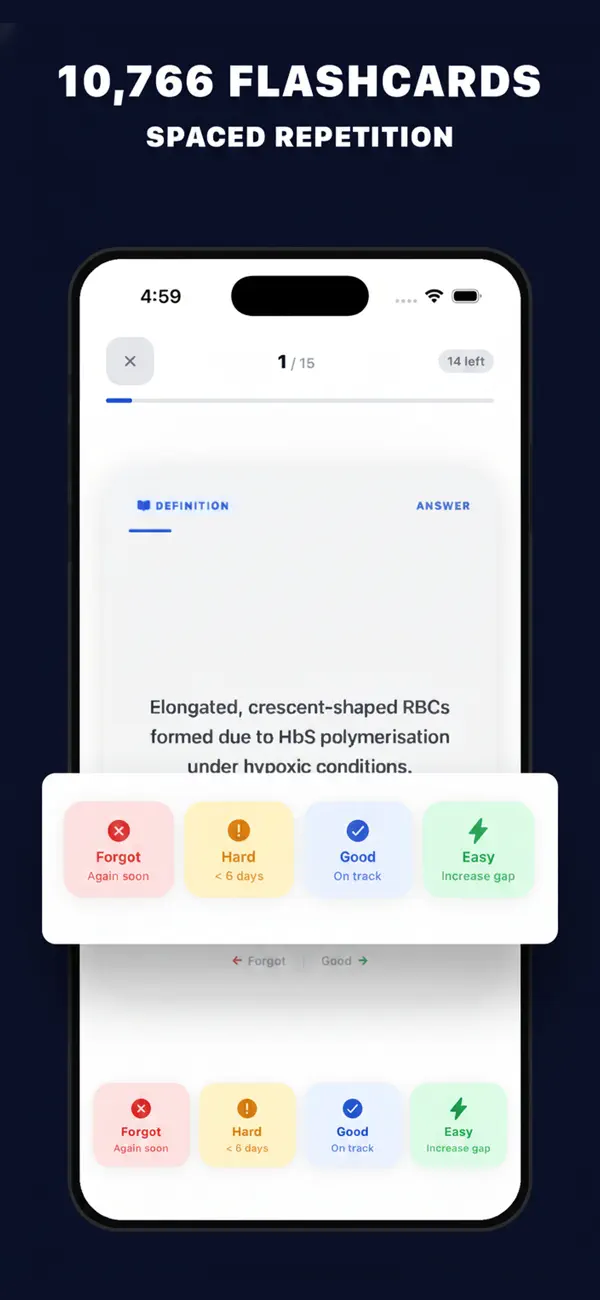
The app ships 11,118 flashcards covering every topic on the GMC Content Map, scheduled by an SM-2 spaced-repetition algorithm: rate a card Forgot, Hard, Good or Easy and its next appearance moves to match your memory. There is nothing to download, import, sync or maintain, which is the part of Anki that quietly eats revision evenings.

Spaced repetition, minus the hobby
Anki works, and half its users end up spending real hours on deck curation: hunting a shared deck that matches the Content Map, patching gaps, fixing formatting, managing add-ons and sync conflicts. The scheduling science is the part that passes exams; the administration is overhead. Here the deck is already built to the same blueprint as the question bank, and the only decision left is honest self-rating.
The four ratings do real work. Forgot resets a card to tomorrow; Easy sends it weeks away. Over a revision cycle the due-pile becomes a precise map of what your memory is actually holding.
Cards and questions, linked by topic
Flashcards hold definitions, thresholds, first-line treatments and red flags: the floor of your knowledge. Questions test whether you can use them inside a vignette. Because both are organised under the same topics, a rough flashcard session on, say, abnormal blood films points straight at the matching notes and questions, and your accuracy chart shows whether the loop is closing.
Where the due-pile fits in a day
A due-pile deals in thirty-second units, which makes it the one revision format that survives a clinical day: a corridor wait, a bus stop, the ten minutes before a teaching session. Clear it once a day and long-term recall compounds in the background while your desk hours stay free for questions and mocks. If you would still rather run Anki, the comparison pieces below are candid about when that is the right call.
Quick answers
- Can I make my own cards in the app?
- The 11,118 cards come pre-written and Content Map-organised, and the app focuses on scheduling them well rather than on authoring tools. If hand-making cards is core to how you learn, Anki remains the better authoring environment.
- What does missing a week do to the schedule?
- The due cards accumulate and wait. Nothing resets and no progress is lost; your first session back is simply longer, and the scheduler recalibrates from how you rate those cards.